
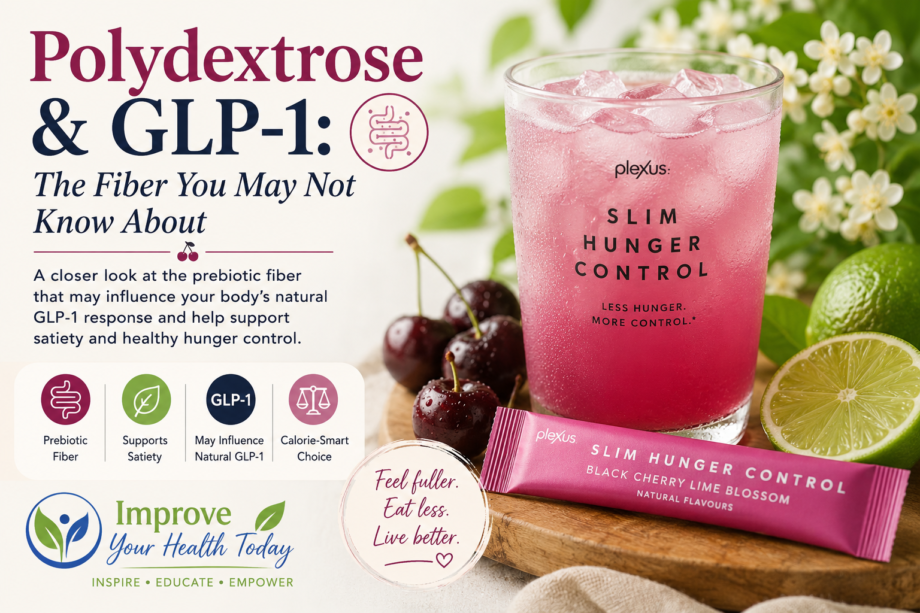
If you’ve paid any attention to health and weight-loss news lately, you’ve probably heard the term GLP-1.
But here’s something you may not have heard:
Certain types of dietary fiber may influence the body’s own natural GLP-1 response.
One particularly interesting example is polydextrose.
I became curious about this little-known ingredient after discovering it in Plexus Slim® Hunger Control. At first glance, “polydextrose” sounds suspiciously like sugar. But once I started looking into it, I discovered that it behaves very differently in the body—and there is some fascinating research surrounding polydextrose, appetite and satiety.
So, what exactly is polydextrose, and what does it have to do with GLP-1?
Let’s take a closer look.
First, What Is GLP-1?
GLP-1 stands for glucagon-like peptide-1. It’s a hormone your body naturally produces, primarily in the gut after you eat.
Among its many roles, GLP-1 participates in the complex communication between the digestive system, pancreas and brain. It is involved in regulating glucose-dependent insulin secretion, slowing gastric emptying and signaling satiety.
In simple terms, GLP-1 is one of the signals involved in telling your brain that you’ve eaten.
That’s one reason GLP-1 has become such a huge topic in weight management.
However, there’s an important distinction.
The GLP-1 your body naturally produces is not the same thing as taking a prescription GLP-1 receptor agonist. Foods, fibers and supplements that may influence natural GLP-1 secretion should never be considered equivalent to prescription medications.
Still, learning how nutrition interacts with our natural appetite-regulating hormones is an exciting area of research.
And that’s where polydextrose gets interesting.
What Is Polydextrose?
Despite its name, polydextrose isn’t simply another form of ordinary sugar.
It is a highly branched glucose polymer used as a soluble dietary fiber. Its unusual structure makes it resistant to much of the digestion that ordinary carbohydrates undergo in the upper gastrointestinal tract.
Instead, much of it continues into the large intestine, where it can be partially fermented by gut bacteria.
Because relatively little energy is obtained from it compared with ordinary digestible carbohydrates, polydextrose is also considered a low-calorie fiber. The U.S. FDA permits a caloric value of 1 calorie per gram for polydextrose for food-labeling purposes.
And that’s only part of what makes it interesting.
Polydextrose and the Gut
We hear the word prebiotic everywhere these days, but probiotics and prebiotics aren’t the same thing.
Probiotics are live microorganisms.
Prebiotics are substrates that can be utilized by microorganisms in our gut and potentially confer a health benefit.
Because polydextrose largely escapes digestion in the upper digestive tract and reaches the colon, it can be fermented by intestinal bacteria.
That interaction between dietary fiber and the gut is especially fascinating because researchers are increasingly studying how signals originating in our gastrointestinal tract can influence things such as satiety and appetite.
Which brings us to GLP-1.
The Polydextrose–GLP-1 Connection
This is the part that initially caught my attention.
Researchers have actually studied what happens to GLP-1 after people consume polydextrose.
In one randomized, double-blind, placebo-controlled crossover study, 18 adults with obesity consumed a meal with either 15 grams of polydextrose or a placebo.
Researchers found that the polydextrose treatment produced a significantly greater post-meal GLP-1 response than the placebo.
Even more interesting, participants reported less hunger during the post-meal period.
That’s intriguing.
But it doesn’t mean drinking polydextrose suddenly turns your body into its own version of a GLP-1 medication.
It means researchers have observed that, under particular experimental conditions, consuming polydextrose can influence naturally produced GLP-1 and subjective hunger.
That’s a much more accurate—and still pretty fascinating—way to look at it.
Could Polydextrose Help You Feel Fuller?
Potentially.
Polydextrose has also been studied independently of GLP-1 for its effects on satiety and subsequent food intake.
In one randomized crossover trial, healthy men consumed a fruit smoothie containing 12 grams of polydextrose before being offered a buffet lunch. Researchers examined whether the added fiber affected feelings of fullness and how much participants subsequently ate.
Taken together, research suggests that polydextrose may help support satiety and may influence subsequent energy intake under some conditions.
But there’s an important word there:
May.
Satiety isn’t controlled by one ingredient or one hormone.
Your overall diet, how much protein and fiber you consume, sleep, activity level, stress, eating patterns and many other factors can influence hunger and food intake.
That’s why I think of polydextrose as a potentially useful tool, not a magic solution.
Why Fiber Matters When You’re Trying to Manage Your Weight
This may actually be the bigger story.
When people think about losing weight, the conversation often revolves around what they need to remove from their diet.
Less sugar.
Less snacking.
Smaller portions.
Fewer calories.
But sometimes it’s helpful to think about what we can add.
Protein and fiber are two nutrients that can make meals and snacks more satisfying.
If something helps you feel satisfied between meals, maintaining healthier eating habits may become easier than simply trying to rely on willpower when you’re hungry.
That’s what makes the research surrounding fibers such as polydextrose worth following.
So Where Did I Discover Polydextrose?
This brings me back to the product that started my research in the first place:
Plexus Slim® Hunger Control – Black Cherry Lime Blossom.
I was intrigued by the Hunger Control name, but rather than stopping at the marketing on the front of the package, I wanted to know:
What’s actually in it?
And that’s when polydextrose caught my attention.
According to the ingredient information for the product, the formula contains three ingredients I wanted to investigate:
Polydextrose, Malabar tamarind fruit peel extract and chromium (III) nicotinate.
We’ve already talked about the ingredient I find most interesting—polydextrose—but let’s look briefly at the other two.
Malabar Tamarind — Garcinia gummi-gutta
You may recognize Malabar tamarind by another commonly used name: Garcinia cambogia.
It is a fruit-bearing tree native to parts of India and Southeast Asia. Its rind contains hydroxycitric acid (HCA), which has been investigated for potential effects on appetite and body weight.
This is one area where it’s important not to overstate the evidence.
Research on Garcinia/HCA for weight loss has produced mixed results. A systematic review of randomized trials found a small short-term difference in weight loss compared with placebo, but the researchers concluded that the magnitude was small and its clinical significance uncertain.
The U.S. National Center for Complementary and Integrative Health similarly says it remains unclear whether Garcinia products meaningfully help with weight loss. It also notes reports of liver injury associated with some Garcinia-containing products, which is worth knowing when considering supplements.
For me, polydextrose remains the much more interesting part of the Hunger Control story.
What About Chromium?
The formula also contains chromium (III) nicotinate.
Chromium is a trace mineral involved in research surrounding carbohydrate, fat and protein metabolism and insulin action, although scientists still don’t completely understand its role.
You will sometimes see chromium promoted heavily for weight loss or blood-sugar control. Again, that’s an area where we need to keep expectations realistic.
Research into chromium supplementation and blood glucose has produced mixed results, and clinical trials examining chromium for weight loss have generally shown, at most, very small effects.
So I wouldn’t look at chromium as a miracle weight-loss ingredient.
It’s simply another component of the overall formula.
Is This a “Natural Ozempic”?
No—and I think this is really important.
The popularity of GLP-1 medications has led to an explosion of products and ingredients online being described as things like “nature’s Ozempic” or “natural GLP-1.”
I don’t think that’s a helpful comparison.
Prescription GLP-1 and related medications are pharmacological treatments specifically designed to act on hormone receptors and can produce powerful, sustained effects.
Polydextrose is dietary fiber.
Research suggesting that a fiber may influence your body’s natural secretion of GLP-1 does not mean it acts like a prescription GLP-1 medication.
But that doesn’t make the nutritional science any less interesting.
In fact, I think understanding how ordinary nutrition interacts with our gut, appetite signals and natural hormones is fascinating in its own right.
Who Might Find Hunger Control Helpful?
For me, the appeal of a product like Plexus Slim® Hunger Control isn’t about expecting a drink to magically make weight disappear.
It’s about having another potential tool for the times when hunger makes healthy choices difficult.
If you’re trying to manage portions, reduce unnecessary snacking or simply feel more satisfied between meals, incorporating more fiber into your overall eating pattern can make sense.
And knowing why an ingredient is included makes me much more comfortable recommending a product than simply repeating what’s written on the package.
A Fiber Worth Knowing About
Before researching this article, polydextrose probably wasn’t a word most of us would have associated with GLP-1.
But that’s exactly why I wanted to write about it.
The science of appetite is much more complicated than simply telling ourselves to eat less.
Our digestive system and brain are constantly communicating through hormones, nerves, nutrients and signals that scientists are still working to fully understand.
Research showing that a soluble fiber such as polydextrose may influence satiety and the body’s natural GLP-1 response gives us another fascinating glimpse into that relationship.
Does that make polydextrose a miracle weight-loss ingredient?
No.
Does it mean Plexus Slim Hunger Control is equivalent to a GLP-1 medication?
Absolutely not.
But does it make polydextrose an ingredient worth knowing about—particularly if you’re interested in fiber, gut health, appetite and healthy weight management?
I certainly think so.
And sometimes understanding what’s actually inside a product is the first step toward making a more informed decision about whether it belongs in your healthy lifestyle.
Interested in Trying Plexus Slim® Hunger Control?
Plexus Slim® Hunger Control Black Cherry Lime Blossom is the product that led me down this polydextrose rabbit hole in the first place.
LEARN MORE ABOUT SLIM HUNGER CONTROL
Important Note
This article is for educational purposes only and isn’t intended to diagnose, treat, cure or prevent any disease or replace individualized medical advice. Dietary supplements aren’t a substitute for a balanced diet and healthy lifestyle. Supplements can also interact with medications or may not be appropriate for everyone. For example, NIH resources note potential medication interactions with chromium, while NCCIH advises discussing Garcinia products with a healthcare provider if you take medications and notes reports of liver injury associated with some Garcinia-containing products.
If you’re pregnant or breastfeeding, have a medical condition, take prescription medication or have questions about whether a supplement is appropriate for you, speak with your healthcare professional.
Sources & Further Reading
For readers who like digging into the science, I would link to the human clinical trial examining polydextrose, GLP-1 and hunger, the randomized trial examining polydextrose and satiety, the FDA information on polydextrose and dietary fiber, the NIH fact sheet on chromium and the NCCIH overview of Garcinia cambogia/Malabar tamarind.